
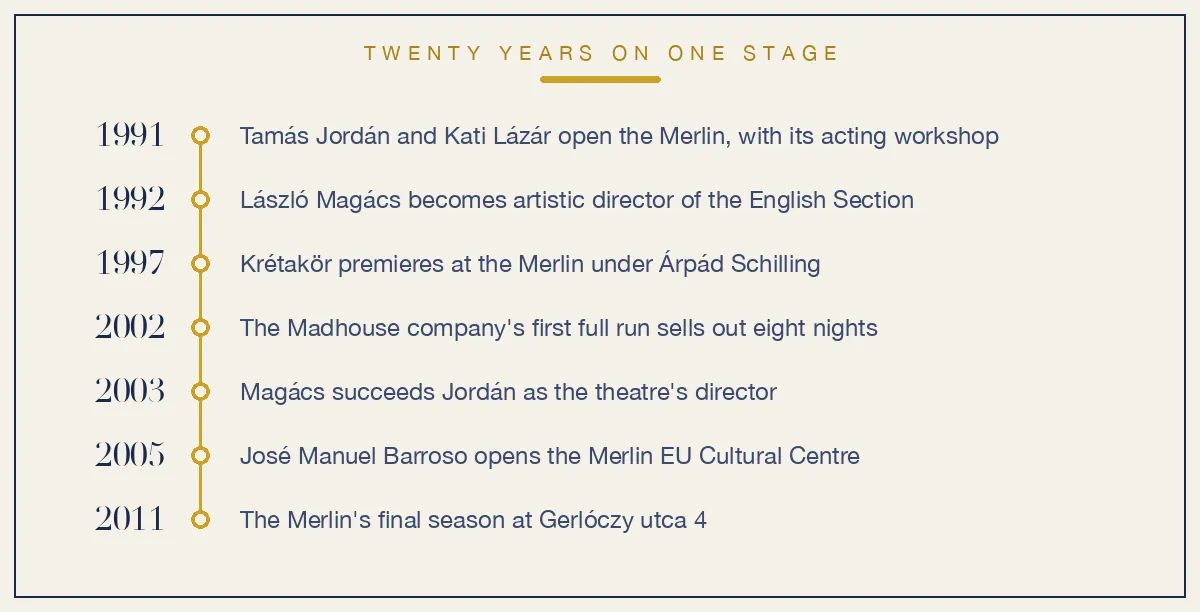
The Merlin Theatre was founded in 1991 by the actor-director Tamás Jordán and the actress Kati Lázár, who ran its acting school together; László Magács led its English-language section from 1992 and the whole theatre from 2003. Around them grew the companies that defined the venue — the English-language Madhouse troupe, and a young Krétakör among the Hungarian ensembles it hosted.

Tamás Jordán
Born in Budapest on 15 January 1943, Jordán was already an established actor when he co-founded the Merlin, and he directed it from 1991 to 2003 (Hungarian Wikipedia). What he did next measures his standing: he ran Hungary’s National Theatre from 1 January 2003 to 30 June 2008, and Szombathely’s city council founded the Weöres Sándor Színház in September 2007 on his concept, with Jordán as its director. The Merlin, in other words, was built by someone who went on to lead the country’s flagship stage.
Kati Lázár
Lázár, born in Nagyvárad (Oradea) on 14 December 1948, co-founded the theatre and its school and is recorded as “a member of the Merlin Theatre since 1991, where she is head of its school and one of its founders” (Hungarian Wikipedia). A distinctive character actress on stage and screen across five decades, she received the Kossuth Prize — Hungary’s highest artistic honour — in 2004, with the Merlin’s creation among the work cited.
László Magács
Magács (b. 1959) is the underwritten figure of the story. From 1992 he spent ten years as artistic director of the Merlin’s English Section, then directed the whole theatre from 2003 — through its club-era reinvention — until 2012, past the closure itself (Hungarian Wikipedia). It was his English Section that made the Merlin, in the venue’s own later words, “Hungary’s first English-language theatre”.
The English-language companies
The best-documented resident troupe is Madhouse, founded by three London-trained actors — Jon Fenner, Matt Devere and Mike Kelly. Kelly had first come to Budapest as a student in 1991 and connected with Jordán and Magács at the Merlin; a 2004 interview on the National Theatre’s website records the company’s real start: “We started an eight-day run in the year 2002. It was a huge success, full houses, and so this is how Madhouse started.” The pairing lasted to the end — the company was still performing with the Merlin in its final years.
Budapest’s English-language scene of the era also included the long-running improv troupe Scallabouche, active since 1998. It is often remembered in the same breath as the Merlin, but we have found no public record of a formal Scallabouche residency at the theatre, so we do not claim one.
The Hungarian companies it raised
The Merlin’s stated mission included giving stages to independent ensembles, and its most consequential guest was Krétakör — Árpád Schilling’s company, later one of Europe’s most acclaimed. Krétakör premiered “Kicsi” at the Merlin on 30 September 1997, two years into its existence (Hungarian Wikipedia); the Merlin’s own Wikipedia entry credits the theatre with helping companies “that today enjoy international success” find their feet. Alongside the guests ran the founders’ own school, the Merlin Színészképző Műhely, from the theatre’s first year.
Significant productions and events
The theatre’s event history beyond the companies rests mainly on the Hungarian Wikipedia entry, so we attribute these rather than assert them: in 2004 the Merlin staged bEUgró, a cultural showcase for the EU’s new member states; in 2005 European Commission President José Manuel Barroso opened the Merlin European Union Cultural Centre in the building; and from 2007 the “Merlin Energia” series brought scientists — Nobel laureates among them — to the stage. The same entry lists visiting companies from the Russian physical-theatre group Derevo to the Royal Shakespeare Company, and credits the venue with establishing English-language theatre in Hungary.
The stage they all shared was a 1928 transformer station; the first three years also housed a celebrated jazz club. The story ends with the closure at the end of 2011 — and the founders’ work is set in the venue’s full arc on our main history page.
Sources
- Jordán Tamás (színművész) — Hungarian Wikipedia · English Wikipedia
- Lázár Kati — Hungarian Wikipedia · English Wikipedia
- Magács László — Hungarian Wikipedia
- Merlin Színház — Hungarian Wikipedia
- Krétakör Színház — Hungarian Wikipedia
- “A Madhouse Experience” — interview, nemzetiszinhaz.hu, October 2004 (offline; quoted from the archived text)
Facts checked 14 August 2026 against the sources above; single-source claims are attributed in the text. merlinbudapest.org is an independent history site with no connection to the people described. Spotted an error? Use the Report a problem link in the footer.