
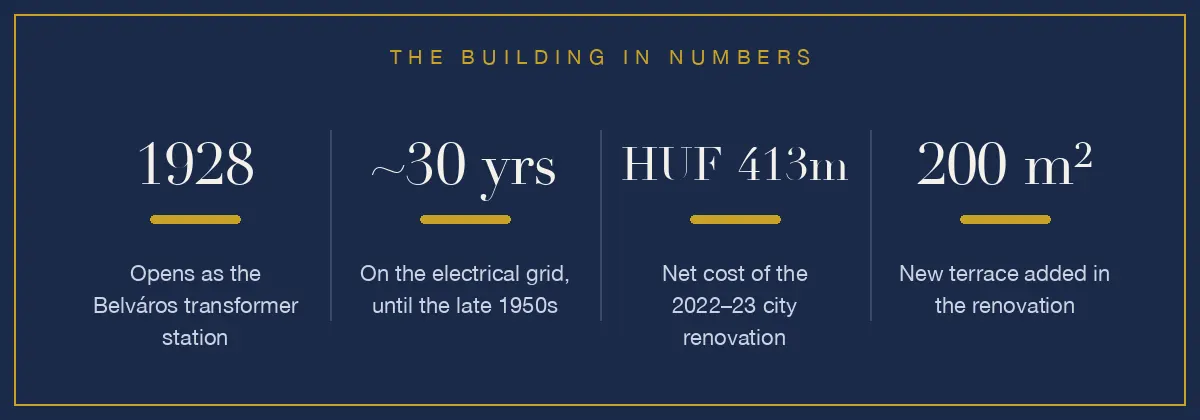
Gerlóczy utca 4 opened in 1928 as downtown Budapest’s electrical transformer station — a two-storey Art Deco building by the architect Virgil Borbíró. It fed the Belváros grid until the late 1950s, became the Merlin Theatre in 1991, stood empty from the end of 2011, and was renovated by the city in 2022–23 for a net HUF 413 million. This is the building’s story.
The architect: Virgil Borbíró, born Bierbauer
The building’s designer appears in sources under two names, and both are correct. He was born Virgil Bierbauer in Nagyenyed in 1893 and later Hungarianised his surname to Borbíró; he died in Budapest in 1956 (Hungarian Wikipedia; Budapest100). He was no jobbing engineer: an architectural historian and theorist as well as a practitioner, editor of the influential journal Tér és Forma, and a corresponding member of the Hungarian Academy of Sciences. The city’s 150th-anniversary site calls him “the era’s outstanding architect” (150.budapest.hu).
One dating note for the careful reader: the Hungarian Wikipedia’s list of his works enters the commission as the City Hall direct-current substation of 1926–27, while Pestbuda and the city date the finished building to 1928. Design and completion dates a year or two apart are normal; we use 1928, the completion year both city sources give.
A transformer station in the middle of Pest
The commission was infrastructure: the Belvárosi Áramátalakító Állomás, the Inner City current-converter station, built on the City Hall block bounded by Városház utca, Bárczy István utca, Károly körút and Gerlóczy utca (Pestbuda, 2022). Borbíró dressed the machine hall in Art Deco: a disciplined two-storey street front on a quiet side street, with a tall open hall behind it. Pestbuda describes it plainly as “the two-storey, Art Deco style building”.
It did its electrical job for roughly three decades, serving “until the end of the 1950s” (Pestbuda). What the rooms held between the grid and the stage is thinly documented — sources skip from substation to civic use without naming interim tenants, and we have found no detailed public record of those middle decades.
From grid to stage, 1991
In 1991 Tamás Jordán and Kati Lázár turned the old hall into the Merlin Színház — a theatre in a building never meant to hold an audience, whose industrial bones became its character. The theatre era, its people and companies and its jazz club, ran twenty years; the venue’s own 2008 website still introduced the address as “the elegant art-deco building of a former transformer house next to City Hall” (the venue’s archived site, 2008). The building was last renovated in that era in 1995, and after the theatre closed at the end of 2011 it stood empty.
The 2022–23 renovation
On Monday 11 July 2022 the city signed the renovation contract: net HUF 413 million, design by the Nanavízió architecture studio, with completion timed for Budapest’s 150th unification anniversary in 2023 (Pestbuda EN, 2022). The scheme kept the known Merlin spaces and added a terrace of around 200 square metres. The contractor’s name does not appear in the coverage we have found — the articles say only that the agreement was signed “with the contractor”.
The city presented the reopened building as spaces “suited to hosting numerous functions and events” — concerts, dance and theatre performances, exhibitions and conferences (150.budapest.hu). It reopened without the Merlin name; our main history page covers what stands there today.
Is the building listed?
We have found no public record of formal heritage protection for Gerlóczy utca 4 specifically. The city’s own material calls it an “important industrial monument” — descriptive respect, not a legal status. If a listing exists, it has not surfaced in the sources available online as of August 2026.
Sources
- Pestbuda: Kezdődik a volt Merlin Színház épületének felújítása (14 July 2022)
- Pestbuda (EN): The renovation of the former Merlin Theater building begins (14 July 2022)
- 150.budapest.hu: Megújult a Merlin épülete (2023)
- Borbiró Virgil — Hungarian Wikipedia
- Bierbauer (Borbíró) Virgil — Budapest100
- Pestbuda: A modern építészet úttörője — 130 éve született Borbíró Virgil (6 March 2023)
- merlinbudapest.org “Bemutatkozó” page, archived 25 October 2008 — Wayback Machine
Facts checked 14 August 2026 against the sources above. merlinbudapest.org is an independent history site with no connection to the building’s owners or operators. Spotted an error? Use the Report a problem link in the footer.