Start with the Page, not the post. If a local vendor has a real Facebook Page, you can see when it was created, what it used to be called, and which countries its admins sit in. That check takes about thirty seconds. Add one review search outside Facebook and you will screen out most fake sellers before you spend a dollar.
Where local vendors actually show up
Three places do most of the work. Business Pages are the front door for shops, tradespeople, and restaurants. Marketplace listings carry private sellers and small shops side by side, and our Marketplace explainer covers how listings and local pickup work.
The third place is local buy-sell-trade and neighborhood Groups. That is where someone asks who to call for a roof or a haircut and gets real names with context. Groups are the best lead source and the worst verification source. Five neighbors naming the same plumber is a strong start, not proof.
Read the Page transparency panel
Open the vendor’s Page, scroll to the About area, and expand the transparency section. As of 2026, Page transparency shows the date the Page was created, any past name changes, and the countries where the people managing it are located.
Two things should slow you down. One is a Page created a few weeks ago that is already running heavy ads. The other is a business calling itself local while its admins sit in another country. Name changes matter too. A Page that sold phone cases last year and now books roof repairs is recycling an old audience.
Reviews and Recommendations have limits
Recommendations replaced star ratings. People answer yes or no and can add a comment. Facebook’s own help page says it does not verify that the person actually bought the product or used the service.
So cross-check somewhere else. Search the business name on Google Business Profile and look it up in the BBB directory. A vendor with 200 glowing Facebook recommendations and no trace anywhere else is showing you marketing, not a track record.
Vet a vendor before you pay
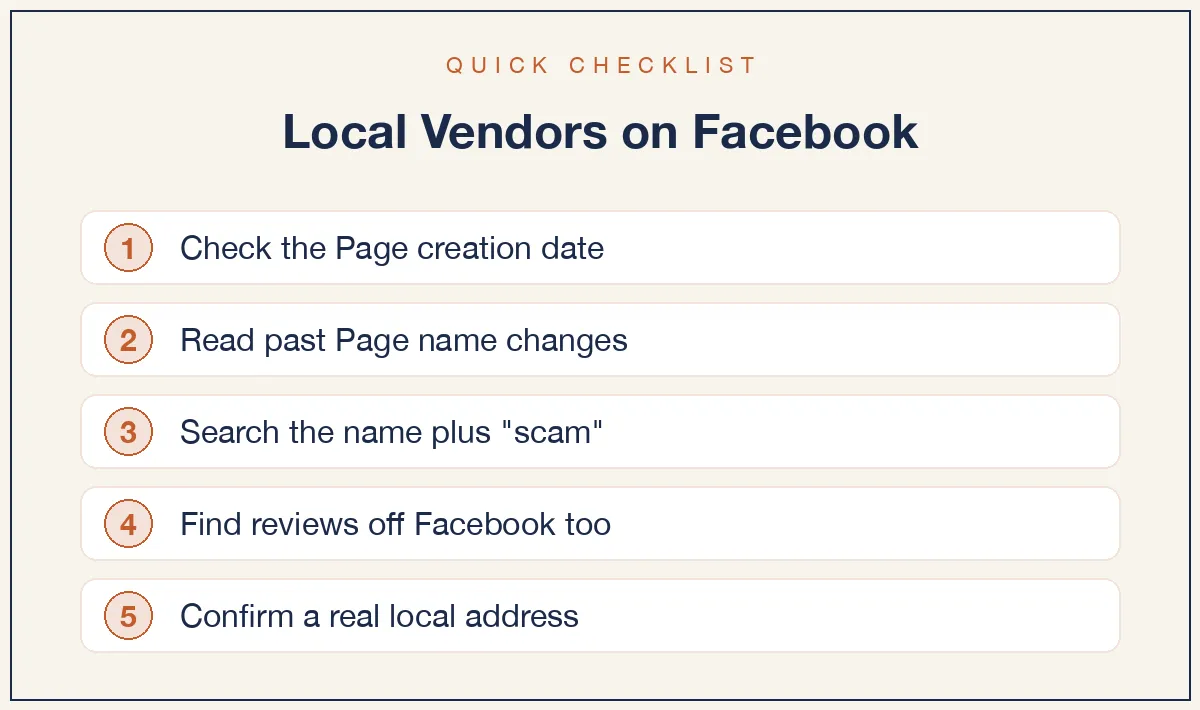
- Check the Page creation date
- Read past Page name changes
- Search the name plus “scam”
- Find reviews off Facebook too
- Confirm a real local address
Pay in a way you can undo
This is where the money is lost. Nearly 30% of people who reported losing money to a scam in 2025 said it started on social media, adding up to $2.1 billion in reported losses, according to the FTC.
The clearest warning sign is how someone asks you to pay. If a stranger insists on a gift card, wire transfer, crypto, or a payment app, stop there. None of those give you a way to claw the money back. A credit card or a checkout with buyer protection does.
For small local deals, cash at pickup after you have seen the item is still fine, which is the approach in our guide to finding local deals near you. If a vendor takes your money and vanishes, report it at ReportFraud.ftc.gov and to your state consumer protection office.